
Image created with Bard
In this post, I want to talk about managing connections.
How many friends can you have, and how might you prioritize them?
Managing Connections as You Get Older
As you grow older, you never stop meeting people. You meet new work buddies, and new friends of friends, and new hobby-homies.
But you can’t keep accumulating new friends every year. You only room in your life for so many connections, so if a new one enters the scene, an old one will squirt out.
How should you think about each of these friends, and how much energy to give to them?
Below I’ll share how I categorize my relationships, and then I’ll share a research-based model for the task.

My Personal System:
I think about my connections in three different buckets.
My Attachment Figures
These are people who I have a vulnerable and committed tie with. There is a depth and consistency of connection where our anxious-avoidant attachments are at play.
These connections require thorough communication.
This category would include my partner Angela. I’ve also had an on-and-off attachment relationship with my friend Eric. And I used to have an attachment bond with my intentional community (the community did feel like its own entity in a weird way).
How many: I think I can only have 1 or 2 of these at a time. Maaaaybe 3, though that’s pushing it.
My Fellow Path Walkers
This is a group of people who I feel “in touch” with. Where there’s some on-and-off text thread going and some frequency of Zoom calls.
We more-or-less know what’s going on in each others’ lives, and if I happen to be traveling near where they live, I’ll try to visit.
We tend to share primary values. And regardless of how often we see each other, it feels like we’re walking the life path together.
How many: For me, this is a constellation of about 10 people. I tend to feel in “active touch” with only 2-4 of these friends at any given time. And the greater group of 10 seems to take turns subbing in and out of the “active touch” space.
I’m not certain about my system here. It might be better to crystalize a 2-4 instead of keeping it fluid. And is 10 too much? All to be figured out. But it’s been working reasonably well so far.
People I Care About
This includes very old friends who I love and keep in loose touch with but don’t share much in common with anymore.
This group also includes friends who I have experienced deep connection with in the past, but we haven’t had another active period since then. There might be a renaissance where we’ll go through another deep connection period again, and there might not be.
I’ll exchange occasional emails with some folks in this group. But we don’t usually connect over Zoom or in person.
I love everyone in this group and feel cared for by them. And even if we don’t keep in touch, it feels meaningful to know they are there.
How many: This one is a little hard to count, but it’s probably in the range of 10-15. Then there’s a dozen more folks who used to be in this space, but we completely lost touch—though if either of us reached out, that person would reincarnate back into this category.
Random People
When I can, I love making space to meet up with people I’ve never met before.
It’s like listening to a new musical artist or trying a new cafe. There’s something about feeling an entirely new connection and exploring the universe from a new person’s eyes that I find quite invigorating.
Sometimes we’ll hit it off and keep meeting. Possibly finding ourselves in a deeper realm of friendship. Other times, we both feel amply satisfied with our one-off, and we’ll remain Facebook friends.
All Of These Groups Are Important
My social world is an ecosystem. So, while different connections occupy different circles, every friend in every category feels important.
The different layers of the ecosystem have me feel nurtured, inspired, and supported, and allow me to express love, affection, and care.
And this model I presented is just for friends. Family is a whole ‘nother loaf of bread. 🍞
Dunbar’s Concentric Circles
You may have heard of “Dunbar’s Number.” (If you haven’t, it’s 150. And we’ll get to it in a few moments). But ol’ Dunby had a few more numbers up his sleeve than just 150.
There is some scientific criticism of Dunbar’s number, but I think it’s still a useful framework.
Dunbar is an anthropologist. His theory suggests that we hold our relationships in concentric circles. Each circle represents a different type of connection with a different level of intimacy. We can only sustain a certain number of connections of each type. The circle in the middle is the smallest and most intimate. Each bigger circle holds 5x the amount of connections as the previous one.
The numbers are as follows:
- Intimate: 1.5 people. Deep, committed relationships
- Close friends: 5 people. Friends who you’d call in crisis and who would drop everything to come help
- Best friends: 15 people. This 15 includes the previous 6.5 from above. These are our main friends and those we’d trust enough to take care of our kids
- Good friends: 50 people. These are friends who you’d invite to your phat weekend party
- Friends: 150. These are the people who we’d invite to weddings, funerals, and one-in-a-lifetime events. Lots of community-builders hold this number as a holy-grail for community size
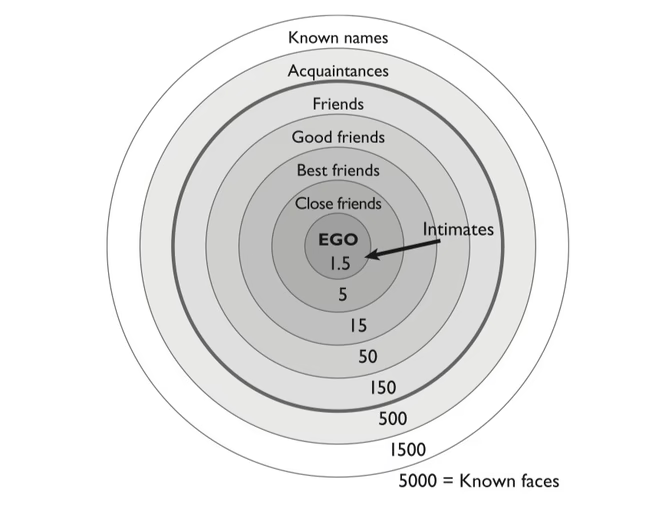
Apparently, when we’re younger, friends move quickly in and out of each circle; one year someone is a best friend, the next year an acquaintance. But typically, as people age, the circles become more ossified (especially if kids enter the picture). At a certain point, your core group of friends is likely to remain your core group.
And as we grow into old age, the outer rings slowly die out. Most people die with just that inner ring of 1.5. (Sad. And a testament to the need for community!)
When we meet a new partner who enters our inner circle, they take up more time and energy. This usually means that one or two people who were in our close friends circle get squeezed into the best friends circle, which then bumps a few people out of that circle, etc.
I’m not certain if Dunbar presents advice, per se. But if nothing else, it’s interesting to see how your own own social eco-system plots into his framework.
Stay connected
If you found this post helpful and would like to stay up to date with other ideas on personal development and relationships, I encourage you to join my newsletter to stay in the loop